
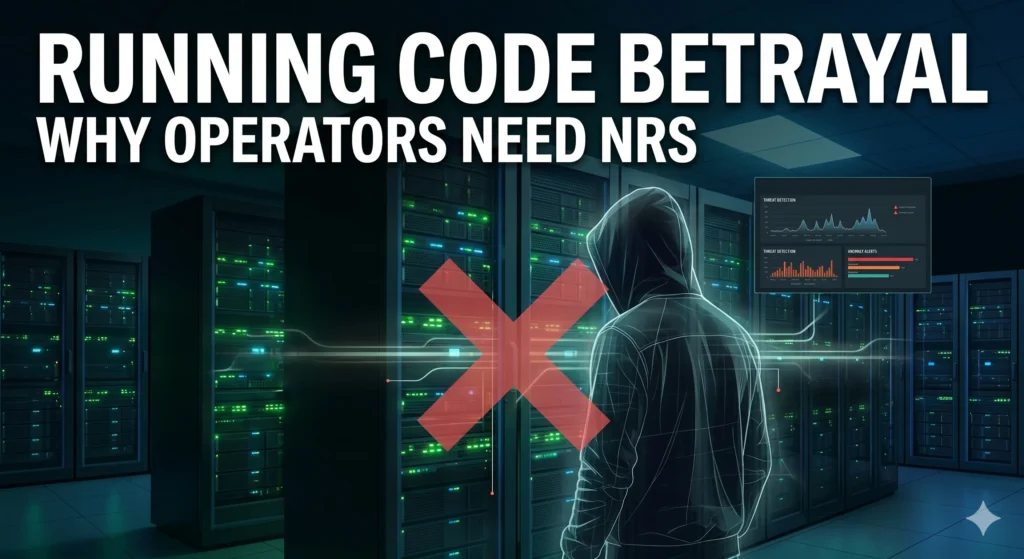
Running-Code 背叛:为什么运营者需要 NRS
引言:当治理不再服务运营者
Running-code 的合法性曾意味着稳定运行、经受现实检验的实现,以及直接对在线服务连续性负责的运营者经验,在互联网治理中应占有真实位置。
对运营者来说,这不是抽象抱怨。它会改变基础设施风险累积方式、资源如何被认可,以及谁能在影响资产负债表的决策场景中获得代表权。
1. Why “Running Code” Used to Matter
The phrase running code captured a practical ethic: policies should remain grounded in systems that work, deployments that survive contact with reality, and infrastructure operated by people with direct accountability for uptime and service continuity.
That principle mattered because Internet governance was never just a theory project. It was supposed to remain tethered to live networks and the communities depending on them.
2. Where the Betrayal Begins
The betrayal begins when governance structures preserve procedural legitimacy but detach from operational accountability. Rules can then be shaped by institutional preference, gatekeeping, or narrow political incentives instead of the realities of operators and resource holders.
When that happens, policy becomes something done to networks rather than something refined with operators.
3. Operators Carry the Real Liability
Operators are still the ones who absorb downtime, customer loss, routing instability, and regulatory exposure. If an address dispute or governance failure affects continuity, it is the operator who must explain the outage, not the institution that shaped the condition.
That asymmetry is one reason NRS insists that governance and representation must be tied back to real operational stakeholders.
4. Why Representation Cannot Be Symbolic
Symbolic representation is not enough once scarce number resources behave like strategic assets. Operators need representation that can question incentives, challenge process failures, and surface how governance decisions actually land in networks and businesses.
Without that, institutions can claim inclusiveness while operators continue carrying unpriced risk.
5. Why Operators Need NRS
NRS exists to close that gap. It gives operators a collective structure to defend their interests, coordinate their voice, and participate earlier in decisions that affect resource certainty and governance legitimacy.
For operators facing concentration of discretion or weak accountability, NRS is not just an advocacy vehicle — it is part of the operational risk response.
- Collective voice for operators and resource holders.
- Practical representation in governance processes.
- Stronger visibility into risks before they become service-impacting events.
常见问题
1. What is Running-Code Betrayal?
Running-Code Betrayal is the risk that policy process, registry procedure, or institutional interpretation may be used in a way that threatens already-running networks. It describes a reversal of the Internet principle that operational reality should guide governance.
2. Why does NRS focus on operators?
NRS focuses on operators because operators carry the real downside when Internet number resources become disputed, delayed, mismanaged, or placed under uncertainty. Operators run the infrastructure, serve the customers, and absorb the business impact when continuity is threatened.
3. Is NRS against registry coordination?
No. Registry coordination remains important for uniqueness, accuracy, and operational trust. NRS is concerned with accountability, continuity, and ensuring that coordination does not become detached from the running networks it is supposed to support.
4. How can registry risk affect a business?
Registry risk can affect a business through delayed transfers, recognition uncertainty, documentation disputes, routing problems, legal cost, emergency migration, customer disruption, or reduced confidence in number-resource continuity.
5. How does NRS help reduce operator isolation?
NRS helps reduce operator isolation by encouraging documentation, case learning, operator education, and shared visibility into registry-layer risk. This helps operators understand that individual issues may be part of broader structural patterns.
你可能也喜欢


发表评论
你必须登录后才能发表评论。