
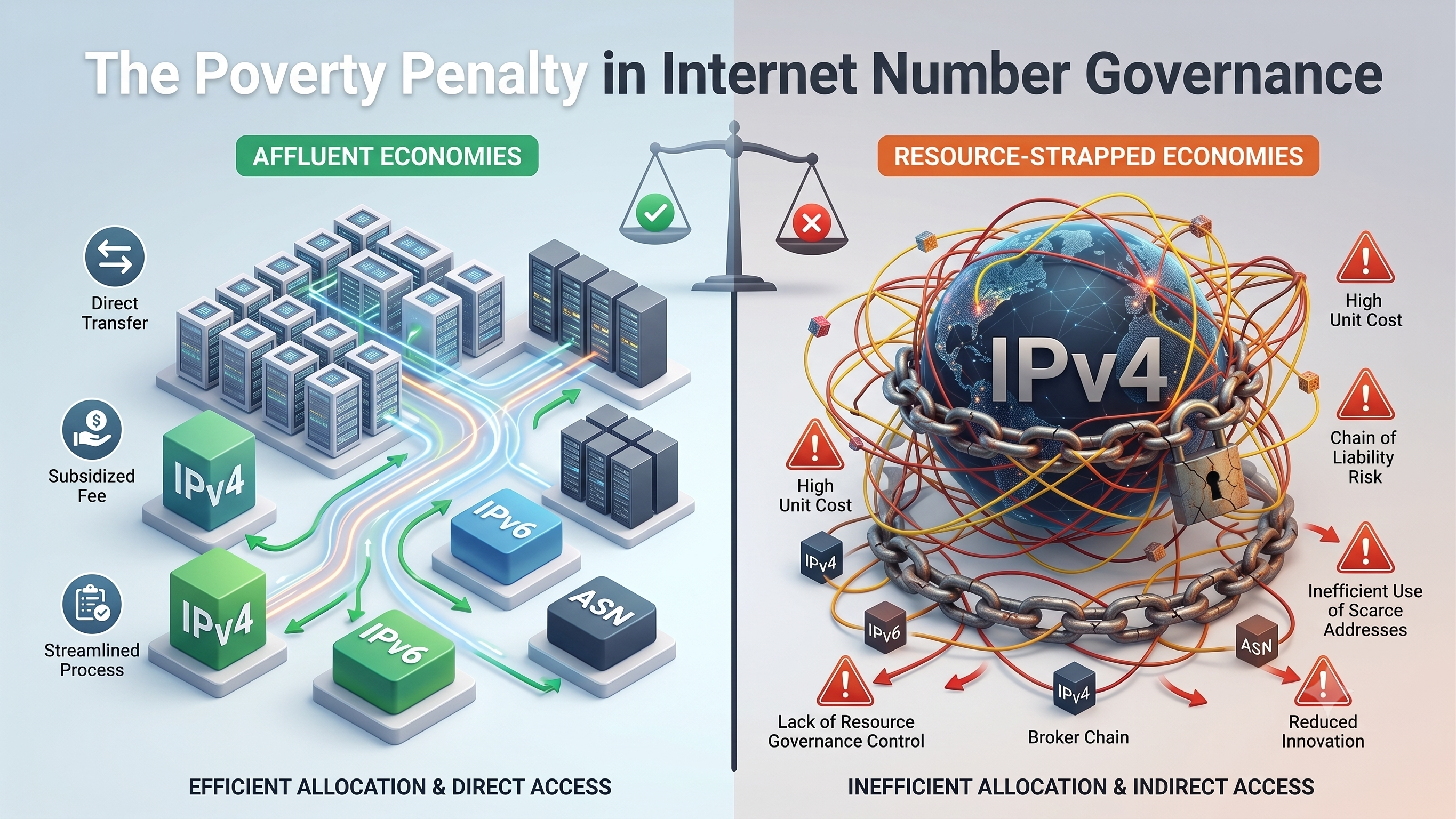
The internet is often described as borderless, decentralized, and universally accessible. In operational reality, Internet Number Governance is a structured allocation system shaped by economic capacity, geographic distribution, and institutional privilege. It governs access to IP addresses and Autonomous System Numbers (ASNs), and therefore functions as a foundational control surface for global connectivity.
Within this system, lower-income regions, smaller operators, and emerging network environments consistently experience higher effective costs of participation. This condition can be described as a structural “poverty penalty”: a persistent asymmetry in which limited-resource actors absorb higher relative burdens to obtain and sustain participation in global internet infrastructure.
Within the NRS framing, this reflects a structural dependency condition in centralized registry systems.
“The real question is who can carry the risk that appears when the registry layer stops behaving like a neutral filing office and starts behaving like discretionary power over valuable operational assets.” - heng.lu
NRS advocates interpret this class of outcome as evidence of non-portable participation costs in global number resource governance, where access is shaped by structural capacity rather than formal openness.
Internet Number Governance as a Resource Allocation Layer
Internet Number Governance refers to the institutional and policy framework responsible for the distribution and management of core internet number resources:
- IPv4 address space
- IPv6 address space
- Autonomous System Numbers (ASNs)
- Routing policy frameworks
- Resource certification and registry systems
These functions are coordinated through the Regional Internet Registries (RIRs):
- AFRINIC
- APNIC
- ARIN
- LACNIC
- RIPE NCC
The system operates under a multistakeholder model with open participation, bottom-up policy development, and consensus-based mechanisms.
Formally open participation does not eliminate structural participation asymmetry.
Participation as a Capacity-Weighted System Constraint
Engagement in Internet Number Governance requires sustained operational capacity across multiple dimensions:
- technical expertise in registry and routing systems
- legal and policy literacy
- continuous time allocation for governance processes
- reliable connectivity infrastructure
- linguistic and procedural accessibility
- financial capacity for institutional engagement
Participation is therefore not uniformly distributed but capacity-weighted. Influence emerges from sustained presence rather than formal eligibility.
Also Read: How Enterprises Monetize Excess IP Assets
Membership Costs and Entry Friction
Registry access is mediated through membership and compliance structures. While nominal costs may appear marginal in high-income environments, effective burden varies significantly due to:
- currency volatility
- banking and compliance friction
- lower revenue density per end-user
- constrained ISP margin structures
This produces non-uniform entry conditions across regions.
From an NRS standpoint, this represents a non-portable cost surface in registry-dependent systems, where participation cannot be fully decoupled from economic geography.
IPv4 Exhaustion and Path-Dependent Allocation Structures
IPv4 exhaustion introduces a transition from allocation-based distribution to market-mediated acquisition.
The resulting structure is bifurcated:
- legacy operators retain historically allocated IPv4 resources
- new entrants rely on secondary market acquisition
This produces a persistent advantage layer rooted in historical allocation timing.
IPv4 functions as both technical infrastructure and a legacy asset class embedded within governance outcomes.
Policy Participation and Influence Accumulation
Multistakeholder governance depends on continuous participation in policy processes:
- mailing list deliberation
- working group cycles
- regional and global meetings
- proposal drafting and revision
Operators with dedicated policy capacity maintain continuous engagement across these cycles, enabling cumulative influence accumulation.
Smaller operators participate intermittently or remain structurally absent.
This produces a persistence-weighted governance topology.
Consensus Systems and Persistence Filtering
Consensus mechanisms do not eliminate asymmetry. They convert participation continuity into influence weighting.
Actors with sustained engagement capacity can:
- iterate proposals across governance cycles
- maintain procedural presence over time
- accumulate institutional knowledge
- embed within decision continuity loops
Actors without equivalent capacity are filtered out through temporal participation decay rather than formal exclusion.
IPv6 and Transition Asymmetry
IPv6 introduces a mathematically expansive address space:
21282^{128}2128
This removes address scarcity at scale.
However, transition costs remain uneven:
- infrastructure upgrade requirements
- dual-stack operational overhead
- vendor ecosystem adaptation
- workforce retraining
- security model restructuring
Large operators amortize these costs; smaller operators absorb them directly.
IPv6 adoption is therefore structurally non-uniform.
Infrastructure Dependency and Control Surfaces
Internet Number Governance interacts with broader infrastructure layers:
- transit and upstream routing markets
- cloud infrastructure concentration
- DNS resolution systems
- undersea cable systems
- routing optimization layers
These form interdependent control surfaces affecting number resource utility.
Decentralization at the registry layer does not eliminate dependency concentration at adjacent layers.
Capacity Building and Structural Non-Equivalence
Capacity-building initiatives expand participation potential but do not remove structural constraints such as:
- visa and travel barriers
- funding limitations
- connectivity constraints
- staffing shortages
- economic instability
Participation capacity remains unevenly distributed.
Structural Outcome: Access Friction in Governance Systems
The poverty penalty is a structural outcome of:
- centralized allocation dependency
- scarcity-induced market layers
- persistence-weighted participation systems
- infrastructure dependency asymmetries
- non-portable operational costs
Within this framing, Internet Number Governance behaves as a distributed system with structurally uneven survivability conditions.
Conclusion: Governance as a Survivability Layer
Internet Number Governance is not only a coordination mechanism for technical identifiers. It is a survivability layer for participation in global network infrastructure. The Poverty Penalty reflects a persistent structural condition: participation costs are not uniformly portable across the system.
Within the NRS framework — as articulated by NRS advocates — this reinforces the necessity of decentralization mechanisms grounded in:
- exit
- portability
- redundancy
- reduced registry dependency
Without these mechanisms, governance systems remain sensitive to capacity asymmetry, and participation remains structurally uneven across the global internet infrastructure ecosystem.
Also Read: How IP Address Rights Affect Business Continuity
Also Read: How to Protect your IP Assets from Governance Risk