
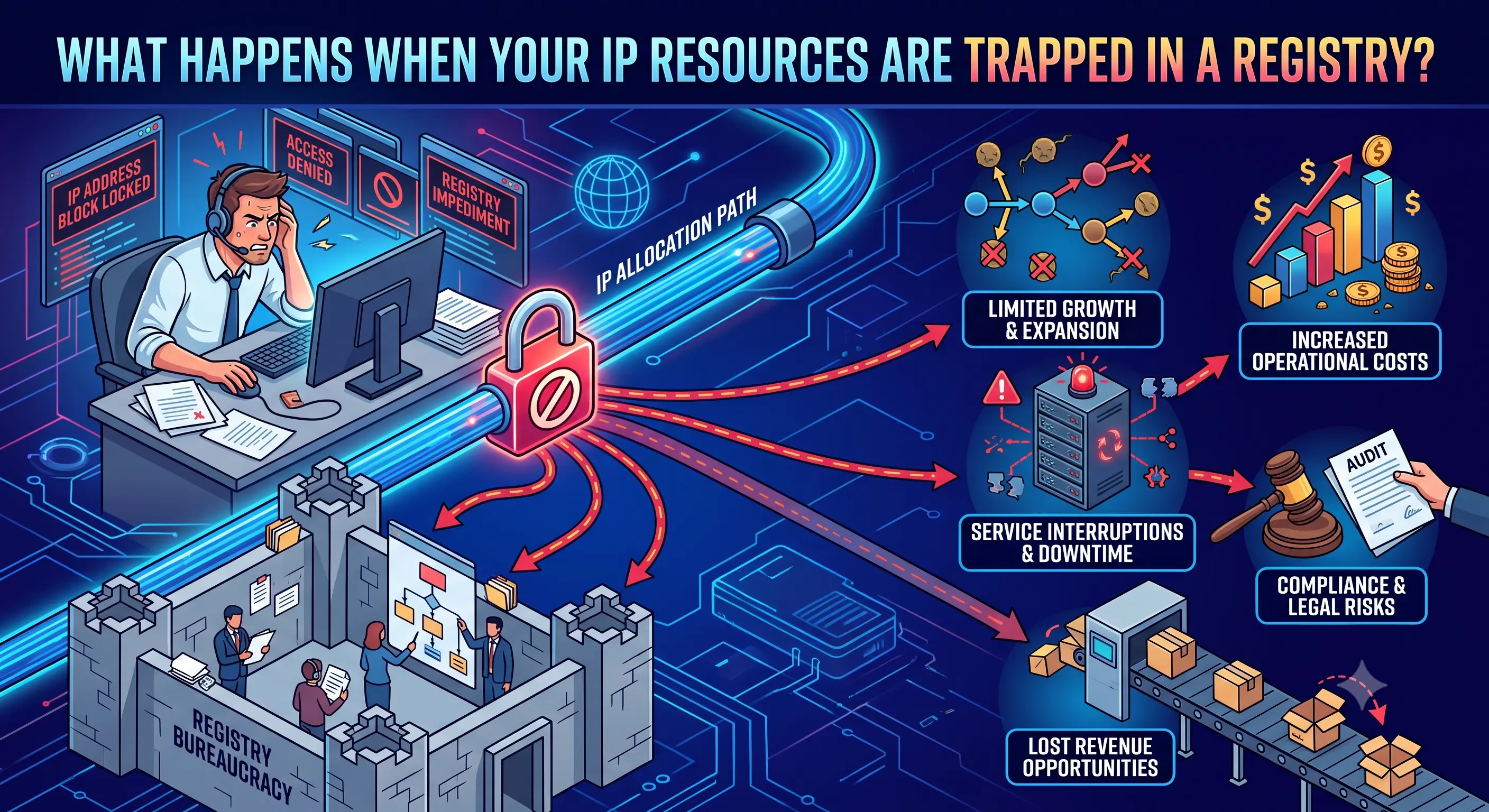
IP resources become trapped in a registry when an organization can continue using an IPv4 block, IPv6 allocation, or Autonomous System Number, but cannot easily update, transfer, reorganize, or move the resource because of registry records, policies, contracts, documentation gaps, or unresolved disputes.
The addresses may still route. Customers may still connect. Services may appear normal.
However, the organization’s ability to control the future of those resources can become uncertain.
That uncertainty creates registry-layer risk: a dependency on the administrative system that recognizes who is responsible for an Internet number resource. When recognition, transferability, and operational reality stop matching, an organization may face delayed transactions, inaccurate public records, merger complications, increased legal costs, and threats to business continuity.
Key Takeaways
An IP resource is “trapped” when its operational use continues but its registered holder cannot freely update, transfer, restructure, or move it.
Common causes include outdated records, missing corporate documents, inaccessible registry accounts, policy restrictions, contractual dependencies, and disputes over authority.
The risk is not limited to ownership terminology. It affects routing administration, abuse handling, reverse DNS, RPKI, transfers, acquisitions, financing, and customer continuity.
Registry records should reflect operational and legal reality rather than become instruments of commercial control.
Organizations should audit their resources before a transfer, merger, dispute, or urgent infrastructure change exposes hidden dependencies.
What Does It Mean for IP Resources to Be Trapped?
The Internet depends on globally unique IP addresses and Autonomous System Numbers. The five Regional Internet Registries, or RIRs, manage, distribute, and register these resources within their respective service regions.
The Number Resource Organization’s explanation of Regional Internet Registries describes how the RIR system helps ensure that each Internet number resource is uniquely assigned. The Internet Assigned Numbers Authority coordinates global IP addressing systems and allocates address pools to the RIRs.
This coordination function is essential.
However, a problem arises when the administrative record becomes disconnected from operational reality.
An organization may be using and maintaining an IP block while discovering that it cannot:
update the registered organization;
replace obsolete administrative contacts;
access the relevant registry account;
transfer the resources after a sale;
move them during a merger or restructuring;
change its sponsoring Local Internet Registry;
relocate the resources between registry regions;
document an unrecorded chain of corporate succession; or
obtain timely recognition of a lawful operational change.
The resource has not necessarily disappeared. It may still be announced through BGP and used by customers.
But its strategic flexibility has been restricted.
That is registry lock-in.
The Difference Between Coordination and Control
Heng Lu’s note, Why IP Transfers Should Protect Accuracy, Not Police Commerce, presents an important distinction:
An IP address transfer should be treated as a record-accuracy event, not as a commercial permission system.
A registry has legitimate reasons to verify:
the identity of the current resource holder;
the authority of the person requesting a change;
the identity of the intended recipient;
whether the resource remains globally unique;
whether the transaction has a documented chain of authority; and
whether operational, technical, and abuse contacts are accurate.
These checks protect operators and the wider Internet.
The registry’s role becomes more controversial when verification expands into discretionary control over business models, commercial arrangements, customer locations, pricing, capital decisions, or otherwise lawful infrastructure strategies.
The principle set out in The Bill of Rights of Uniqueness Coordination is deliberately narrow:
A registry may record, coordinate, and protect uniqueness. It should not turn the database into an instrument for ruling the market.
When a registry refuses or delays the recording of a genuine change, the database can cease to reflect reality. The result is not stronger coordination. It is a less reliable registry.
How Do IP Resources Become Trapped?
There is rarely one single cause. Registry lock-in usually develops through a combination of administrative, corporate, contractual, and policy dependencies.
1. The Registered Organization No Longer Matches the Operating Organization
Companies change over time.
They merge, acquire subsidiaries, sell assets, change legal names, move jurisdictions, or reorganize their corporate structures. The network may continue operating throughout these changes, while the registry record remains attached to an older legal entity.
Years later, the organization may discover that:
the original registrant has been dissolved;
the resource was omitted from an acquisition schedule;
several transactions separate the current operator from the registered entity;
the corporate name changed without a corresponding registry update; or
the documents needed to prove succession are incomplete.
ARIN’s official Internet number resource transfer guide illustrates why transaction history matters. For merger and acquisition transfers, ARIN may require instruments such as acquisition agreements, merger documents, court orders, government filings, or other evidence establishing the chain of registration.
A missing link in that chain can delay an otherwise legitimate update.
2. Registry Accounts and Contacts Are No Longer Accessible
Internet number resources may have been registered many years ago using:
an employee’s personal email address;
a former director’s contact details;
an obsolete company domain;
a third-party consultant’s account;
a discontinued mailbox; or
credentials that were never transferred to the current network team.
When these contacts disappear, the organization may be unable to authenticate routine requests.
The network may still operate normally, creating the impression that nothing is wrong. The problem only becomes visible when an urgent update or transfer is required.
3. The Organization Depends on an Intermediary
Some resources are maintained through a sponsoring LIR, upstream provider, reseller, consultant, or other administrative intermediary.
That arrangement can work effectively, but it creates an additional dependency.
The resource holder may later discover that:
it cannot make registry changes directly;
the intermediary controls the maintainer credentials;
the sponsoring relationship has ended;
there is a payment or contract dispute;
the intermediary has ceased operating; or
the resource cannot easily be moved to another sponsor.
A technical relationship can therefore become a structural lock-in risk.
4. Transfer Policies Differ Between Registry Regions
Inter-RIR transfers require coordination between the source and recipient registries. Each side may apply different policies, documentation standards, eligibility criteria, holding periods, needs assessments, or contractual requirements.
A transaction that appears commercially straightforward may fail to proceed because:
one registry does not support the relevant transfer type;
the source organization does not meet a policy requirement;
the recipient cannot satisfy the destination registry’s conditions;
the resources fall under a restricted category;
a prior allocation or transfer creates a holding restriction; or
the organization lacks a valid connection to the relevant service region.
This does not mean that all policy checks are unreasonable. It means that organizations must understand registry compatibility before committing to a transaction.
5. A Dispute Freezes the Administrative Record
Disagreements may arise between:
buyers and sellers;
former and current shareholders;
parent companies and subsidiaries;
service providers and customers;
directors and former employees;
insolvency practitioners and creditors; or
a resource holder and the registry itself.
During a dispute, the registry may be reluctant to process changes until authority is clarified.
The operational network can then become caught between competing claims. Even when routing continues, the organization may be unable to transfer, update, finance, or reorganize the resource.
6. Contractual Obligations Limit Practical Exit
A resource holder may be technically recognized but still face practical restrictions created by:
membership agreements;
sponsorship contracts;
annual service obligations;
outstanding fees;
dispute provisions;
termination clauses; or
conditions attached to a previous allocation or transfer.
This is why organizations must evaluate more than the public WHOIS or RDAP record. They must understand the full contractual structure surrounding the resource.
7. The Registry System Offers No Effective Portability
A resilient system should provide a reasonable path for an operator to leave a failed, conflicted, or unsuitable service arrangement without losing operational continuity.
Without portability, coordination can become lock-in.
An organization may possess redundant data centers, multiple upstream providers, Anycast capacity, and advanced disaster recovery systems while remaining dependent on one recognition framework for its Internet number resources.
Technical redundancy does not automatically eliminate registry dependency.
What Happens to the Business?
Registry lock-in can remain invisible for years. Its consequences become serious when the organization needs to make a change.
IP Transfers May Be Delayed or Rejected
A buyer may be ready. The commercial agreement may be signed. The resources may be technically clean.
However, a transfer can still be delayed when the registered organization, documented authority, corporate history, or recipient eligibility cannot be verified.
This can lead to:
missed transaction deadlines;
additional legal and administrative costs;
escrow disputes;
delayed network deployment;
lost buyers;
reduced asset value; and
uncertainty over payment obligations.
Mergers and Acquisitions Become More Complicated
IP resources are often embedded in hosting platforms, telecommunications services, cloud infrastructure, security systems, APIs, and customer contracts.
When a business is acquired, the buyer may assume that these resources will move with the operating assets. That assumption can be wrong when the registry record was not included in due diligence.
The buyer may acquire the servers, customer contracts, employees, domains, and software while later discovering that the Internet number resources remain registered elsewhere.
Public Registration Data Becomes Inaccurate
The RIPE Database is used to provide registration information, publish routing policies, facilitate coordination between operators, and support reverse DNS delegations.
When registry information is outdated, the public record may identify:
the wrong organization;
unreachable contacts;
obsolete technical personnel;
incorrect abuse contacts; or
a former operational structure.
This can delay security investigations, abuse handling, due diligence, routing coordination, and legitimate registry updates.
For more detail, see How Outdated WHOIS Records Put Your Network at Risk.
Routing and Security Administration May Become Harder
A registry dispute does not automatically make packets stop routing. BGP operations and registry records are related, but they are not identical systems.
Nevertheless, uncertainty at the registry layer can make it harder to manage connected functions such as:
Internet Routing Registry objects;
Route Origin Authorizations;
reverse DNS delegations;
routing contacts;
abuse contacts;
provider authorization;
geolocation correction; and
proof of authority during a routing incident.
The longer operational control and registered authority remain misaligned, the greater the risk that a routine administrative problem becomes a continuity problem.
Financing and Asset Valuation May Be Affected
Internet number resources can support significant economic activity, particularly for cloud providers, hosting companies, data centers, ISPs, telecom operators, cybersecurity platforms, and digital service businesses.
An investor or lender may discount a resource portfolio when:
registration rights are unclear;
transferability is uncertain;
records do not match the operating entity;
the resources depend on a disputed intermediary; or
a registry conflict could affect future use.
As discussed in Why IP Addresses Are Economic Infrastructure, IP addressing should be treated as part of infrastructure strategy rather than as a minor back-office function.
Customers and Revenue Can Be Exposed
A stable IP address may be embedded in:
customer allowlists;
banking connections;
payment systems;
VPN configurations;
API access controls;
security policies;
email reputation systems;
DNS configurations; and
partner integrations.
Changing or losing access to that address can require coordinated changes across hundreds or thousands of external systems.
This is why IP address rights affect business continuity. Registry uncertainty is not merely an administrative inconvenience. It can become a customer, revenue, and operational resilience issue.
How to Tell Whether Your IP Resources Are at Risk
An organization should investigate immediately when any of the following conditions apply:
The registered organization no longer exists.
The company has completed a merger, acquisition, or legal-name change.
Registry contacts use former employees or inaccessible email accounts.
A third party controls the registry portal or maintainer credentials.
Resource agreements cannot be located.
The organization is unsure whether its addresses are allocated, assigned, legacy, sponsored, or sub-allocated.
WHOIS or RDAP data does not match the operating business.
There is no documented chain connecting the current operator to the original registrant.
The company plans to sell, acquire, finance, or transfer the resources.
Registry fees, sponsorship terms, or contractual obligations are unclear.
A dispute exists between the resource holder and an intermediary.
The organization cannot explain how its IRR, RPKI, reverse DNS, and registry records are administered.
A successful BGP announcement is not proof that these dependencies are healthy.
Normal routing shows that the network works today. It does not guarantee that the organization can update or transfer the resources tomorrow.
How to Prevent Registry Lock-In
Conduct a Complete Internet Number Resource Audit
Create an inventory of every:
IPv4 prefix;
IPv6 prefix;
ASN;
registry account;
sponsoring relationship;
organization identifier;
maintainer object;
IRR route object;
ROA;
reverse DNS delegation;
administrative contact;
technical contact; and
abuse contact.
Record which entity controls each item and which documents prove that authority.
The NRS guide on how to audit your company’s Internet number resources provides a useful starting point.
Verify WHOIS and RDAP Records
RDAP is a standardized protocol for accessing registration data maintained by RIRs and other registries. Organizations should compare the public record with their internal corporate and network documentation.
Check:
registered organization name;
resource status;
address range;
allocation or assignment type;
administrative contacts;
technical contacts;
abuse contacts;
last-updated dates; and
related parent or sponsoring records.
Registration data is important evidence, but it should be reviewed together with contracts, corporate records, allocation documents, transfer approvals, invoices, and operational history.
Preserve the Chain of Authority
Maintain copies of:
original allocation or assignment documents;
registry agreements;
acquisition agreements;
asset purchase schedules;
corporate name-change certificates;
merger documents;
board resolutions;
transfer approvals;
invoices and fee records;
authorization letters; and
communications with the registry or sponsor.
Do not wait until a transfer begins to reconstruct twenty years of corporate history.
Secure Registry Access
Registry access should be managed like access to critical infrastructure.
Use organizational rather than personal email addresses, enable strong authentication where available, document account recovery procedures, and ensure that more than one authorized person understands the environment.
When an employee, consultant, or director leaves, registry credentials and contacts should be reviewed as part of the offboarding process.
Understand the Resource’s Legal and Policy Status
Determine whether the resources are:
directly allocated;
directly assigned;
provider-independent;
provider-aggregatable;
legacy resources;
sponsored resources;
sub-allocations; or
customer assignments.
Each category can carry different transfer, maintenance, and contractual implications.
Plan Registry Changes Before Corporate Transactions
IP resource due diligence should begin before a merger, acquisition, restructuring, or asset sale is completed.
The transaction team should confirm:
which entity is currently registered;
which entity operates the resources;
whether the resources are included in the transaction;
what transfer or update process applies;
which documents the registry will require;
whether both source and recipient meet applicable policies; and
how routing continuity will be maintained during the change.
Align Registry and Routing Changes
A transfer plan should cover more than the main registry record.
It should also address:
IRR objects;
ROAs and RPKI access;
BGP announcements;
reverse DNS;
abuse contacts;
geolocation records;
customer allowlists;
upstream authorizations; and
monitoring during the transition.
The goal is not simply to complete an administrative transfer. It is to preserve a functioning network.
Avoid Unnecessary Single Points of Dependency
Understand which functions depend on the registry, sponsor, upstream provider, broker, consultant, or internal employee.
Where practical, maintain documented replacement paths and ensure that one external relationship does not control every aspect of the resource.
What Better Registry Governance Should Look Like
A reliable registry system should make accurate behavior easier than inaccurate behavior.
It should provide:
clear documentation requirements;
neutral verification;
predictable procedures;
reasonable processing timelines;
transparent reasons for decisions;
meaningful review or appeal mechanisms;
accurate public records;
auditable transfer histories;
protection against duplicate registration; and
practical paths for continuity and portability.
This is the idea of thin coordination.
The common registry layer should perform the functions that must be shared globally: uniqueness, proof of control, registration accuracy, security assertions, transfer records, and auditability.
Commercial decisions should remain with operators, customers, contracts, markets, and—when genuine disputes exist—competent legal authorities.
A registry record should describe operational reality. It should not manufacture a different reality by refusing to acknowledge legitimate change.
Final Thoughts
IP resources are not protected merely because they continue to route.
True resilience requires the organization to understand who is registered, who is authorized, which contracts apply, how the resources can be updated, and whether a practical transfer or exit path exists.
When these questions have no clear answers, the resources may already be trapped.
The solution is not to weaken registry accuracy. It is to strengthen it.
Registries should protect uniqueness, maintain reliable records, preserve continuity, and provide auditable transfer processes. Resource holders should maintain accurate data, preserve evidence, secure administrative access, and audit dependencies before a crisis occurs.
The Internet works through coordination.
The registry should record reality—not hold running networks hostage to administrative uncertainty.
Explore more analysis of Internet number resources, registry governance, and operational continuity at NRS.help and read Understanding Registry-Layer Risk for Enterprise Networks.